Learn How To Reduce Your Risk For Skin Cancer This Summer
Learning Skin cancer is the most common cancer in the United States, but it is also one of the most preventable and treatable when caught early. In fact, one in five Americans will develop skin cancer by the age of 70, and just five or more sunburns can double your risk of developing melanoma, the deadliest form of skin cancer. The good news is that when melanoma is detected early, the five-year survival rate is 99%.
How can I reduce my risk for skin cancer?
While not every case of skin cancer can be prevented, most are linked to ultraviolet (UV) radiation from the sun or tanning beds. Protecting your skin from UV exposure can significantly reduce your risk.
Practice sun safety year-round, even on cloudy or cool days, since UV rays can penetrate clouds and reflect off water, sand, snow and concrete. UV exposure is strongest between 10:00 AM and 4:00 PM, so seek shade whenever possible during those hours.
When outdoors, wear protective clothing, a wide-brimmed hat and UV-blocking sunglasses. Apply a broad-spectrum, water-resistant sunscreen with an SPF of 30 or higher to all exposed skin and reapply every two hours or after swimming or sweating.
Avoid indoor tanning, as tanning beds expose the skin to concentrated UV radiation that increases the risk of skin cancer and premature aging. If you want the look of a tan, choose a self-tanning product instead.
What are the signs of skin cancer?
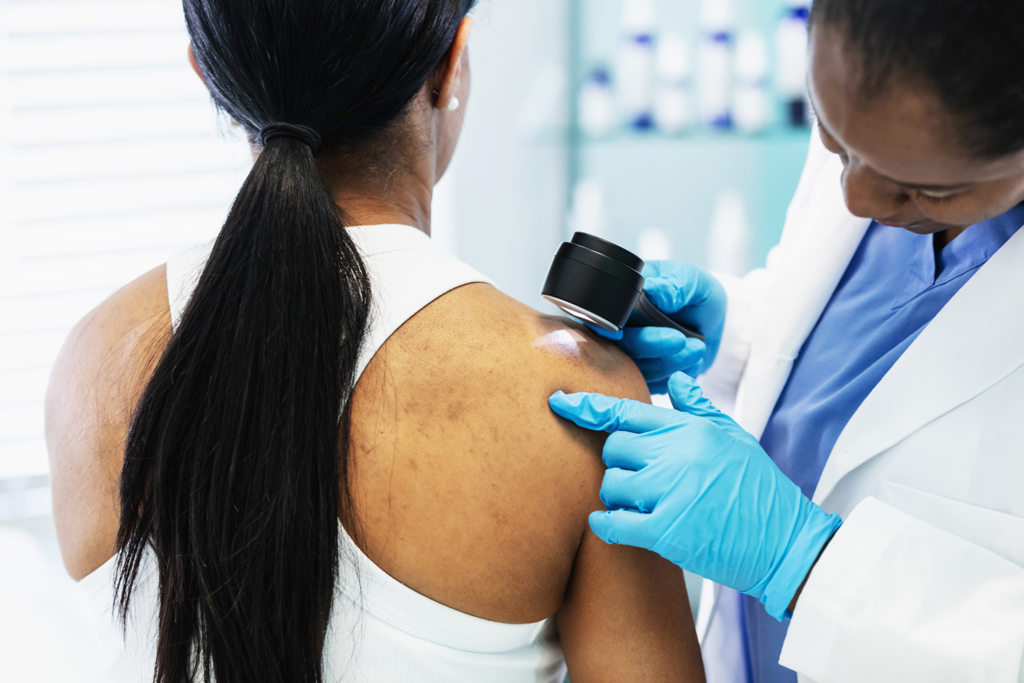
Skin cancer often begins as a new or changing spot on the skin. While some skin cancers cause itching, tenderness, pain or bleeding, many have no symptoms in their early stages.
One of the best ways to identify potential melanoma is by following the ABCDE rule:
A – Asymmetry: One half of the mole or spot does not match the other
B – Border: The edges are irregular, ragged, notched or blurred
C – Color: The color is uneven or includes multiple shades of brown, black, pink, red, white or blue
D – Diameter: The spot is larger than about 6 millimeters (roughly the size of a pencil eraser), although melanomas can be smaller
E – Evolving: The mole or spot changes in size, shape, color or behavior, such as becoming itchy or bleeding
Other warning signs of skin cancer include a shiny bump, rough or scaly patch, sore that does not heal, raised growth that crusts or bleeds or a wart-like or scar-like area with no obvious cause.
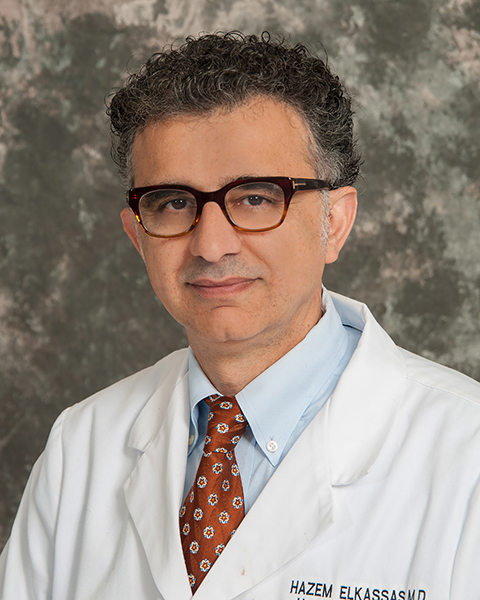
“Although skin cancer most often develops on sun-exposed areas such as the face, scalp, ears, arms and legs, it can occur anywhere on the body, including the palms, soles of the feet, under the nails and genital area,” said Hazem Elkassas, MD, a board-certified physician in internal medicine and medical oncology with Penn Highlands Healthcare.
Any new or changing spot that persists for more than two weeks should be evaluated by a healthcare provider or dermatologist. Early detection greatly improves the chances of successful treatment.
How is skin cancer treated?
Treatment for skin cancer depends on the type, size, location and stage of the cancer. Surgery is the most common treatment and typically removes the cancer along with a small margin of healthy tissue.
“In some cases, particularly for cancers on the face or other sensitive areas, a procedure called Mohs surgery is recommended, in which very thin skin layers are removed while preserving as much healthy tissue as possible,” said Dr. Elkassas.
Early-stage skin cancers may also be treated with topical medications, cryotherapy (freezing), photodynamic therapy or curettage and electrodessication (ED&C), which uses a scraping instrument followed by heat to destroy remaining cancer cells.
More advanced skin cancers may require radiation therapy, chemotherapy, targeted therapy or immunotherapy, depending on the extent of the disease.
Your healthcare team will discuss the benefits, risks and potential side effects of each option to develop a treatment plan tailored to your needs. In some cases, a clinical trial may also provide access to promising new therapies.
If you or a loved one is diagnosed with skin cancer or another form of cancer, the oncology experts at Penn Highlands Healthcare are here for you with experienced care, customized treatments plans and state-of-the-art therapies. The cancer care centers at Penn Highlands offer comprehensive treatment, including robotic surgery, chemotherapy, immunotherapy and radiation therapy close to home. Learn more at www.phhealthcare.org/service/cancercare.